 |
| More than just a degree and the right toys |
Showing posts with label History. Show all posts
Showing posts with label History. Show all posts
Wednesday, 30 May 2012
Defined out of existence


Monday, 28 May 2012
NASA asks future explorers to respect historic landing sites

Tuesday, 24 April 2012
Friday, 20 April 2012
Earth Day

You want clean air, water, green fields and lush forests for the kiddies to romp in? Then build an industrial society with lots of technology and cheap energy cranking out loads of wealth for all. Then you'll have the surplus you need to garden the Earth properly.
Wednesday, 14 March 2012
The fruits of willful ignorance

I shouldn't be too hard on them. It's not as if it's the British Broadcasting Corporation, after all.
Thursday, 22 September 2011
Does it run Windows 8?

Boffins step closer to steam-powered Babbage computerOnly 174 years late. I think they may have some trouble capturing market share with that sort of development cycle.
Friday, 2 September 2011

Friday, 11 March 2011
ZX-81 memories

It's like being able to tell your kids that you were there when they rolled out the Mark I fire.
Monday, 7 March 2011
HMS Dreadnought
Now if only Her Majesty's government gave these boats a higher priority than pouring money down the welfare state black hole, paying housing support to imams who would gleefully slaughter us all and the government refuse to deport, sending tribute to the European Empire, and throwing bank notes at insulting social engineering programmes that shouldn't exist in the first place.
Via Theo Spark.
Thursday, 27 January 2011
Gigo
Part one.
Continuing on yesterday's post, here's a computer documentary from 1969
Part two.
Part three.
Thursday, 23 December 2010
Smithsonian spacesuits
 |
| This never caught on. |
Monday, 29 November 2010
British Things
Queen Victoria was a dotty idiot who deserved nothing better than to have sugar poured on her head by a servant, the British Empire was a monstrosity built entirely on slavery, conquest, and pillage, and "there are no British things".
Quite a servings of lies, distortions, omissions, and half-truths here–too many to deal with at the moment. So, what is it? Left-over Soviet agitprop? A university Trotskyite society screed? A remake of an old Lord Haw Haw broadcast set to music? A clip from some late-night "comedy" show?
Nope. It's from "Horrible Histories"; a BBC "educational" programme aimed at British children. That's right. Children. Apparently, the brief of the BBC is now to make British children ashamed of their country, their history, and their culture.
Okay, fine. So be it. I now await the next installment when the BBC returns the favour and gives the same gleeful muck-throwing treatment to Imperial China, the Ottoman Empire, the Soviet Empire, or the career of a certain middle-eastern camel salesman turned prophet by the name of Mohammed.
I shan't, however, hold my breath in the meantime.
Update: Not surprisingly, Captain Scott gets the same libelous treatment.
Tuesday, 16 November 2010
How Hitler killed a logo

Friday, 29 October 2010
Save the Vulcan

Find the piggy bank, lads.
Thursday, 30 September 2010
Tuesday, 28 September 2010
The first

The Ur shot

It's always in the details.
Friday, 3 September 2010
Child abuse by abusing history
 A straight, white man did this, so it is of no importance whatsoever.
Zombie looks at the Rosencrantz and Guildenstern Are Dead school of history teaching and how it does a disservice to America, children and even reality.
As a retired archaeologist and history professor, this is a particular bête noir of mine. I've always been sickened by the tendency of academics with a leftist agenda to push who are forever demanding "correctives" to traditional history that are invariably less "corrective" than consigning unpersons to the memory hole.
I see it in my daughter's schooling. Her school is actually quite a decent one and not a hotbed of Social Marxism, but last year she came away knowing who Sacajawea was, but not Lewis and Clark and she could rattle off all sorts of things about Amelia Earnhardt, but never heard of Charles Lindbergh.
It gets even worse at the university level. I once took over a course in first year World history and was assigned a doorstop of a textbook written by some maniac who thought that world history was a mammoth exercise in "me, too-ism" with every obscure culture and event on the planet crammed in at the expense of far more important events or even any sort of coherent narrative. Worse, it was an impossible book to teach from because it would have required a five-year class that would have had as much educational value as bolting through the British Museum at flat-out speed while chased by a pack of rabid dogs.
In the end, I dumped it and told my class, "The history of ancient China is fascinating and I'd be delighted to teach it–if this was a course on the history of China. It isn't. It's World history. And if we're going to study the events that shaped our modern society, that means we start in the Fertile Crescent, head for Greece via Egypt, on to to Rome, then we hang about in Europe until the 19th Century, and then bounce back and forth between the United States and the Old World with the odd imperial side trip until we clear the 20th century. That's where our world, everyone on this planet's world, was made and that's what we study. If aficionados of Mesoamerican or Icelandic history feel left out, tough."
Tuesday, 24 August 2010
Past and future
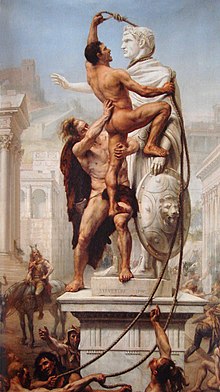 Today is the 1,600th anniversary of the sack of Rome by the Visigoths.
Historic event or preview of what we have in store if we don't admit that civilisation is a good thing and start defending it?
Tuesday, 17 August 2010

Subscribe to:
Posts (Atom)